
The Security Craftsman- August
News & Updates from Pref-Tech – August 2026 Recovery Experts Several years ago, my wife and I sat on opposite ends of a couch in a counselor’s office. We were frustrated, hurt, and exh...



Several years ago, my wife and I sat on opposite ends of a couch in a counselor’s office. We were frustrated, hurt, and exhausted. Like many couples navigating a difficult season, we spent an enormous amount of energy trying to convince one another who was right and who was wrong. We replayed old arguments, defended our positions, and revisited disappointments that should have been left in the past. Every disagreement felt larger than life. Every conflict seemed to take on a momentum of its own.
Then our counselor said something that changed our marriage forever:
“The goal of a healthy marriage is not to eliminate conflict. The goal is to become experts at recovery.”
The statement surprised me because it challenged everything I believed about healthy relationships. Like many people, I assumed the strongest marriages were the ones with the fewest disagreements. I thought relational health was measured by the absence of conflict. Our counselor suggested the exact opposite. Healthy couples still argue. They still disappoint one another. They still experience unmet expectations, misunderstandings, and hurt feelings. The difference is not whether conflict occurs. The difference is how quickly and effectively they recover.
Over time, my wife and I embraced that lesson. We are far from perfect. We still have disagreements. We still occasionally miss one another emotionally. We still say things we wish we could take back. The difference today is our recovery time. Arguments no longer spiral out of control. Hurt feelings do not linger for days or weeks. Neither of us feels compelled to win. Instead, we seek to understand. We acknowledge our shortcomings. We apologize. We forgive. We reconnect. In many ways, we have become recovery experts with one another, and it has become one of the most beautiful aspects of our marriage.
As I have reflected on that lesson over the years, I have become convinced that it applies to virtually every meaningful relationship in life, including those between customers and vendors.
Over the past few months, we have discovered a handful of customers who were not happy with our performance. As painful as that feedback can be, I welcome it. Honest feedback helps us improve. It reveals blind spots. It creates opportunities for growth. Any company serious about excellence should want to know when it has fallen short.
What surprised me was not the dissatisfaction itself. What surprised me was the silence.
Rather than reaching out, engaging in difficult conversations, and working collectively toward solutions, some customers simply disappeared. They ghosted us.
To be fair, I understand the temptation. Every customer reading this has likely experienced disappointment from a vendor. Deadlines are missed. Communication breaks down. Technicians make mistakes. Expectations go unmet. Every vendor reading this has experienced disappointment as well. Customers change priorities. Assumptions prove incorrect. Projects evolve. Tensions emerge. Relationships become strained.
Customer-vendor relationships are uniquely challenging because they combine the complexity of human relationships with the realities of contracts, money, schedules, accountability, and organizational pressures. Human relationships are already difficult. Add business to the equation and the challenge grows exponentially.
Yet when difficulties arise, many organizations choose the same response. Rather than moving toward the problem, they move away from it. Rather than repairing the relationship, they abandon it.
I believe this tendency reflects something much larger occurring within our culture. Modern American life has become remarkably efficient at replacement. We replace phones when a newer model appears. We replace vehicles when they become inconvenient. We replace appliances rather than repair them. Increasingly, we treat relationships the same way.
When a friendship becomes difficult, we withdraw. When a business partnership disappoints us, we disengage. When a vendor falls short, we start looking for a replacement. We have unconsciously adopted the belief that healthy relationships should be easy and that difficulty is evidence something is fundamentally broken.
The problem is that every meaningful relationship in life challenges that assumption.
Strong marriages experience conflict. Strong friendships experience conflict. Strong teams experience conflict. Strong customer-vendor relationships experience conflict.
The healthiest relationships are not those that avoid hardship. They are the ones that learn how to navigate hardship together. In fact, I’ve become convinced that trust is rarely built during seasons when everything is going according to plan. Trust is built when something goes wrong and both parties choose to remain engaged. Anyone can be a good partner when circumstances are favorable. Adversity reveals the true quality of a relationship.
This realization has changed the way I think about evaluating vendors, particularly in our industry.
When a security integrator falls short, the most important question is not, “Did they make a mistake?” Every integrator will make mistakes. Every project will encounter unexpected obstacles. Every company, regardless of its intentions or capabilities, will occasionally disappoint a customer.
The more important question is this:
“What is the heart behind the mistake?”
Do they genuinely care about their customers? Do they communicate honestly? Do they take ownership when things go wrong? Are they willing to tell the truth even when the truth is uncomfortable? Do they remain engaged when challenges arise? Are they committed to finding a solution rather than protecting their reputation?
Those questions reveal far more about the future of a relationship than the original failure itself.
To be clear, not every relationship should be preserved. Some vendors demonstrate a lack of character, integrity, or commitment. Those relationships should end. However, when a vendor has the right heart, when they care deeply, take ownership, and remain committed to improvement, the relationship may be worth fighting for.
I have seen remarkable partnerships emerge from significant challenges. Difficult conversations occur. Accountability is accepted. Solutions are developed. Lessons are learned. Then something unexpected happens. The relationship becomes stronger than it was before the problem emerged. Trust deepens. Respect grows. Communication improves. The struggle itself creates the bond.
When I think back to that counseling session years ago, I realize our counselor offered a lesson that extends far beyond marriage. The strongest relationships are not the relationships that avoid conflict. They are the relationships that become experts at recovery.
For customers, that may mean choosing a difficult conversation instead of silent frustration. Before ending an important business relationship, it may be worth asking whether the vendor has been given a genuine opportunity to repair the damage and restore trust.
For vendors, it means resisting defensiveness when problems arise. It means listening before explaining, taking ownership before assigning blame, and demonstrating sincere concern for the impact created by a mistake.
For all of us, it means recognizing that every meaningful relationship requires work. Repair is hard. Vulnerability is hard. Forgiveness is hard. Honest conversations are hard. Yet so are resentment, mistrust, isolation, and missed opportunities. We all have the opportunity to choose which kind of hard we want to embrace.
My hope is that customers, vendors, employees, and partners alike will choose repair over replacement, engagement over avoidance, and restoration over resignation. Because when people with the right heart work through challenges together, they often build something stronger than what existed before the failure occurred.
The strongest relationships are not those that never break.
They are the ones that know how to heal.
PGRIT,


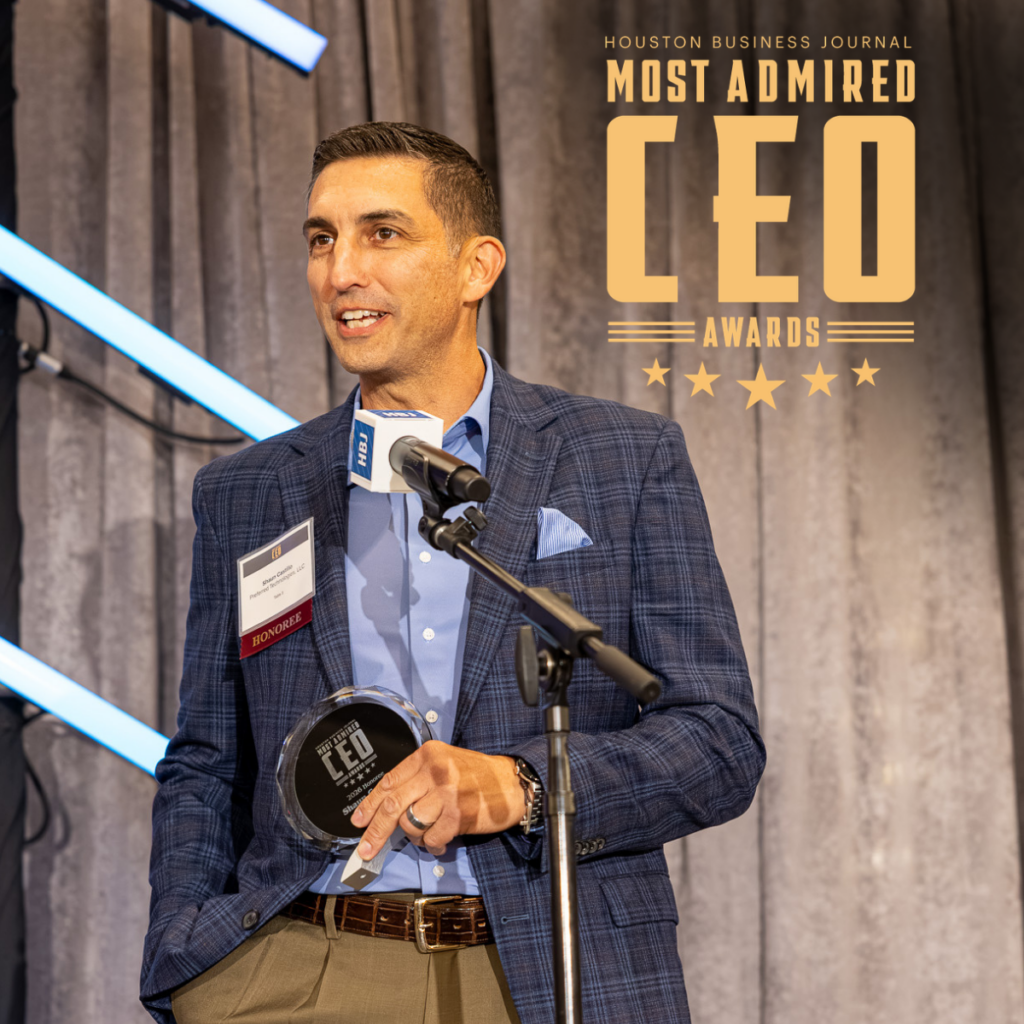
We are pleased to share that Shaun Castillo, CEO of Preferred Technologies, has been named a 2026 Houston Business Journal Most Admired CEO honoree. Throughout his career, Shaun has focused on creating opportunities for others to succeed, building strong teams, and investing in long-term relationships. The recognition places him among a distinguished group of leaders making an impact across the Houston business community.
In early August, Tabatha Brown, Nathan Israel, and Angel Rivera represented Pref‑Tech at AcceleRISE 2026 in San Diego, California. The conference brings together emerging and established leaders from across the security industry to network, share ideas, and develop the skills needed to lead the future of the profession.
Throughout the event, attendees participated in educational sessions, leadership development opportunities, and discussions with industry peers from across the country. By investing in opportunities like AcceleRISE, Pref‑Tech continues to support the growth of its team while staying connected to the people, ideas, and best practices shaping the security industry.

One of the most rewarding aspects of our organization is seeing employees grow and take the next step in their professional journeys. This month, we’re celebrating team members who have recently been promoted or moved into new roles that support their career aspirations. We look forward to seeing their continued success in these new positions.






As part of our ongoing commitment to being trusted security advisors, our Innovation Team continuously evaluates new and emerging technologies that enhance situational awareness, improve response times, and strengthen physical security programs.
Below is a snapshot of new technologies we are actively reviewing and supporting that integrate with modern security platforms.

Radwin provides Point to Point wireless data transmission with a high quality line of radio models.

SFC’s EFOY product provides backup power for solar applications using methanol as fuel for their fuel cells.

TRONTEQ’s line of transit-rated M12 connection switchgear provides multiple options for port count and PoE budgets.

Dallmeier’s Panomera camera provides maximum resolution coverage for very large spaces.

Zero Eyes weapons detection camera analytic uses AI to initially detect a weapon, then hands the alert over to monitoring centers for human verification.
Want to see how these technologies could benefit your security environment?
Click below to read the full article on our website, including key benefits and deployment types for each solution.